Salt Lake City Concrete Cutting, Coring & Wall Sawing
Precision wall sawing, slab sawing, core drilling and GPR scanning for Wasatch Front commercial, industrial and seismic-upgrade projects.
Specialty: Seismic Retrofit Openings, Tech & Data Center Slabs and Airport-Area Industrial Cutting
Tell Us About Your Project
Concrete Cutting Contractors in Salt Lake City: Quick Answer
Concrete cutting contractors in Salt Lake City, Utah open walls, saw slabs, core penetrations and scan reinforced concrete for seismic retrofit openings, tech & data center slabs and airport-area industrial cutting. Success depends on what is inside and around the concrete (lake bonneville sediments, a high water table west of i-15, and wasatch fault seismic reinforcement), scanning for rebar, tendons and utilities before any cut, and slurry, dust and noise control that fits an occupied building. Typical capabilities in this market are listed below and are confirmed project by project with the engineer of record.
The Concrete Cutting Guide for Salt Lake City Owners, GCs and Facility Managers
Salt Lake City sits on the floor of an ancient lake, at the foot of a mountain range, on top of an active fault. Every one of those three facts shows up in how concrete gets cut here. The valley is filled with sediments laid down by Lake Bonneville, the Wasatch Front is crossed by the Wasatch Fault, and the Salt Lake City segment of that fault runs along the eastern edge of the valley. Owners who hold older concrete buildings are often asked to add shear walls, remove obstructions or open up floors, and that kind of work usually starts with a saw, a core rig and a scan rather than a jackhammer.
The work that reaches a concrete cutting contractor here is varied. Downtown, the former rail land around The Gateway and the blocks near the arena and convention center continue to see renovation, hotel conversion and tenant improvement work inside existing structures. On the west side, the Northwest Quadrant and the airport business park area are built around warehouses, distribution and cargo, where dock doors, equipment trenches and slab repairs are routine. South of downtown, South Salt Lake holds older industrial buildings and conversion projects. To the east, the University of Utah Research Park hosts laboratories and offices where one wrong core through a slab can interrupt research.
Why a specialty cutting contractor rather than a general contractor swinging a breaker? Because the cut is the risk. A wall opening in a reinforced shear wall changes the load path. A slab trench in a building with post-tensioned tendons can sever a cable that carries real force. A core near a conduit bank can shut a floor down. Specialty crews scan first with ground penetrating radar, mark what they find, choose the saw, wire or core bit that fits the member, and control dust and slurry to meet silica rules. The structural engineer defines what may be cut; the cutting contractor delivers it cleanly and safely.
This guide covers the local conditions that matter for Salt Lake City concrete cutting: soils and groundwater, the permit path through Salt Lake City Building Services, the cost and schedule drivers that tend to surprise owners, the seasons, and a realistic timeline. Corridor and service pages go deeper. All figures are described in ranges or hedged terms, and permit, code and licensing requirements change, so confirm current rules with the city, the state and your engineer before you commit to a scope.
What drives concrete cutting cost and schedule in Salt Lake City
No prices are quoted on this page; these are the local factors that shape a concrete cutting budget.
Cutting is priced on access, depth, reinforcement and the controls the building requires, not on a flat rate per cut. These are the local factors that most often move a Salt Lake City quote or schedule.
| Driver | How it affects cost and schedule |
|---|---|
| Tier 1: Primary drivers | |
| Reinforcement density and structural limits | Seismic detailing in Wasatch Front buildings often means closely spaced bars in walls, columns and slabs. Dense steel slows diamond cutting, wears blades faster and may force the engineer to specify exact opening locations. Expect more time per linear foot in shear walls than in a plain slab. |
| Scanning and post-tension risk | Older garages, podium decks and some tenant floors contain post-tensioned tendons or tightly packed conduit. GPR scanning before cutting adds a small amount of time and removes the largest source of surprise. A scan that reveals tendons can also change the planned cut location and the schedule. |
| Access, occupancy and noise | Downtown and Research Park work often happens in occupied buildings with freight elevator windows, quiet hours and tenant protection requirements. Dust and noise controls, floor protection and after-hours labor can matter as much as the cut itself. |
| Tier 2: Additional drivers | |
| Slurry capture and disposal | Wet cutting generates alkaline slurry that must be vacuumed and disposed of properly rather than sent to a storm drain. Thick walls, deep core runs and long trenches increase volume. The route to a disposal site and any required containment are real line items. |
| Debris removal and structural shoring | Removing cut sections takes rigging, small cranes or hoists when the pieces are heavy. In retrofit work, temporary shoring or sequencing requirements from the engineer can add steps before the opening is released. |
| Permit review and inspection timing | Structural openings need permit review before cutting starts, and some scopes require inspection before closing up. Review time varies with department workload, so schedule float is better planned than assumed. |
Cutting Seasons & Climate in Salt Lake City
Salt Lake City has a semi-arid, four-season climate: cold winters, hot dry summers and relatively little rain. Interior cutting is mostly unaffected, which is why many retrofit and tenant projects schedule it in winter. Exterior sawing, trenching and wet coring face freezing nights from late fall through early spring. Water lines and slurry vacuums can freeze, frozen subgrade complicates trench restoration, and cold slabs can chip at saw exits if the work is rushed. Contractors typically plan heated water supply, insulated hoses or drained lines overnight. Winter inversions also trap particulates, which makes dust control and vacuum capture a visible issue for neighbors.
Summer brings heat that dries cuts quickly, which is good for blade cooling but harder on crew comfort; wet cutting still depends on a reliable water supply and slurry capture, and hot slabs can have expansion tension that closes saw kerfs. Spring runoff and thunderstorms can send water through exterior work areas, so containment barriers matter. The best exterior schedule windows are usually late spring through early fall. Airport-area and industrial work tends to follow tenant move-in dates and freight cycles more than weather, so set windows with the owner early.
Planning budget and schedule? Read the Salt Lake City concrete cutting cost & permits guide.
Salt Lake City Concrete Cutting Services
Four core scopes, each with its own local considerations.
Wall Sawing & Opening Creation
Door, window, dock and stair openings cut through reinforced and shear walls without overcutting corners.
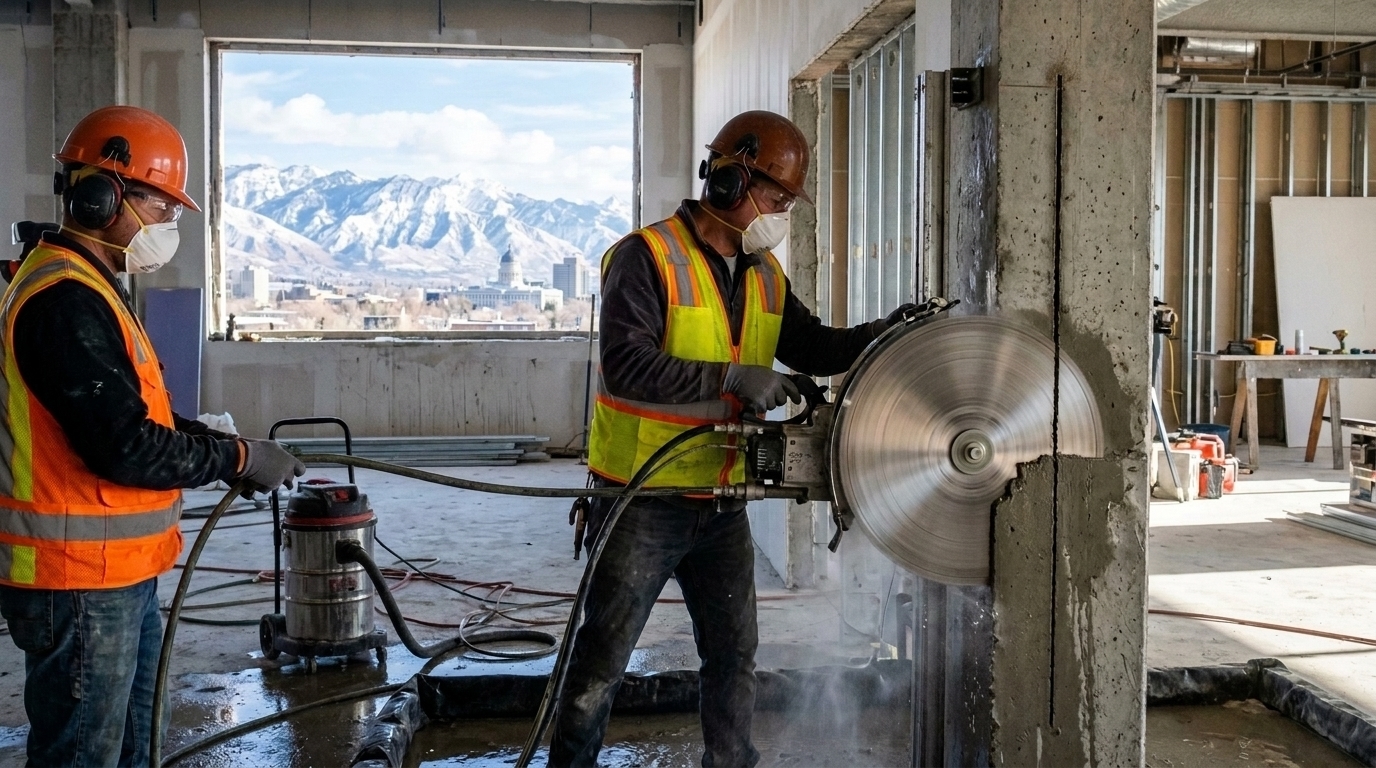
Wall sawing uses a track-mounted hydraulic saw with a diamond blade to cut straight, dimensionally accurate openings in reinforced concrete walls. In Salt Lake City, the most common reasons are new door and dock openings, stair and elevator shafts, window enlargements and seismic retrofit pockets. The cuts are clean enough for framing or lintels to follow with minimal rework. Typical walls range from thin infill panels to thick basement and shear walls, and the saw is chosen and anchored to suit the thickness.
Slab Sawing & Trench Cutting
Straight, clean slab cuts for plumbing, electrical and data-center trenching in occupied buildings.
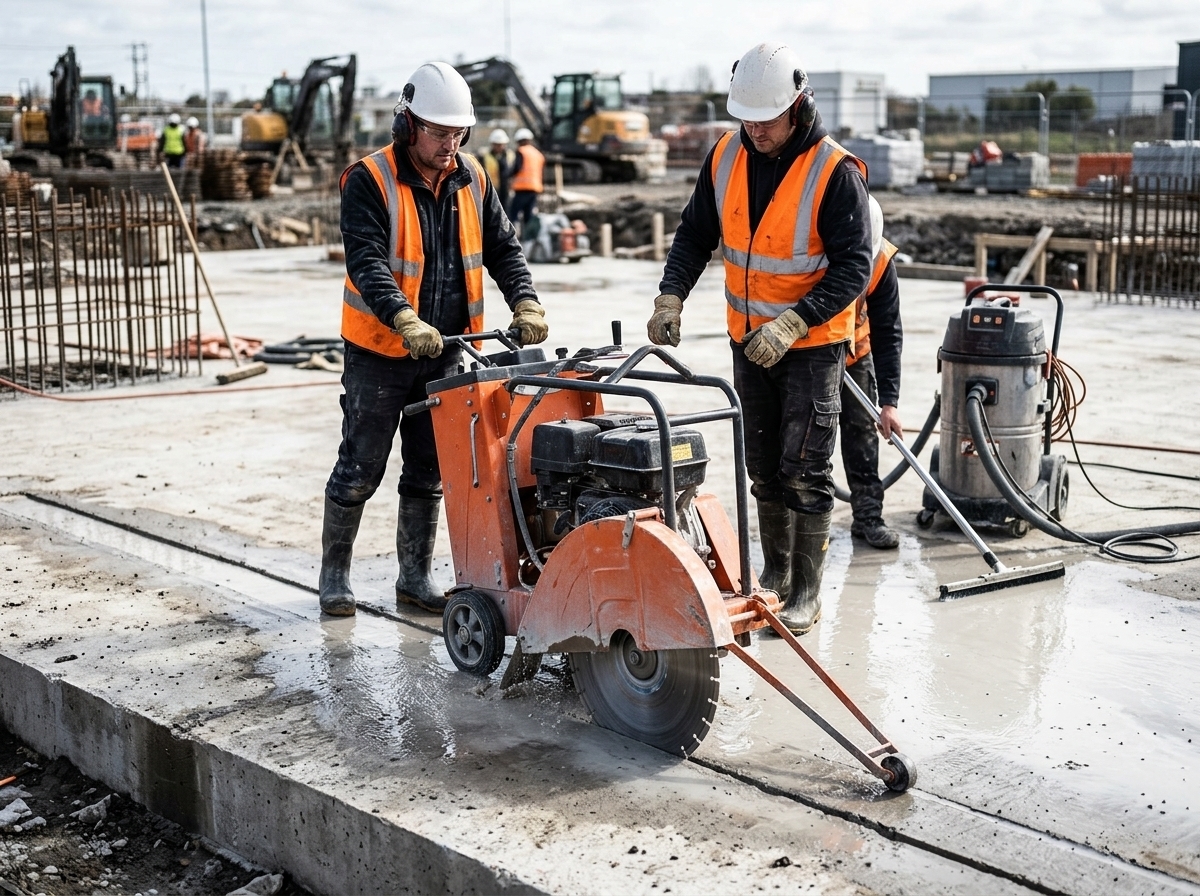
Slab sawing uses a walk-behind or track-mounted saw to make straight cuts in slabs on grade and elevated decks. In Salt Lake City, typical uses include trenching for new plumbing and drains, data and electrical runs in office and data-center spaces, openings for stairs and risers, and control joint cutting or repair in warehouse floors. Saw cuts can also be made to isolate a repair area before demolition so the edge of the remaining slab stays intact.
Core Drilling & Penetrations
Wet core drilling for MEP sleeves, anchors, sampling and deep penetrations through slabs and walls.
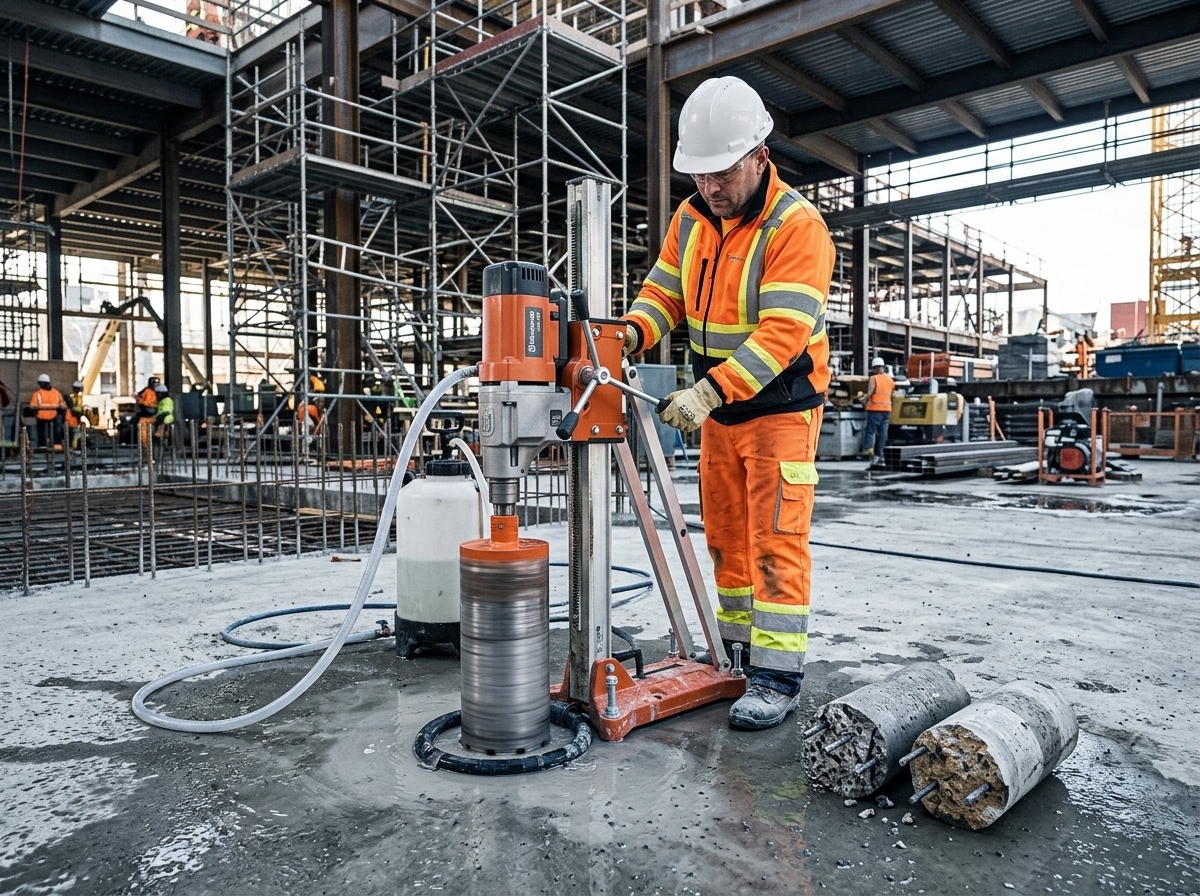
Core drilling uses a diamond bit and a rig anchored to the slab or wall to cut round holes from small diameters up to large penetrations. In Salt Lake City, cores are used for plumbing and electrical sleeves, HVAC and lab piping, anchor and dowel holes for seismic retrofit, and samples for strength testing or investigation. Core sizes are matched to the sleeve, pipe, duct or anchor being installed so the annular gap is minimal.
GPR Scanning & Concrete Imaging
Ground-penetrating radar to locate rebar, post-tension tendons and conduits before any cut is made.
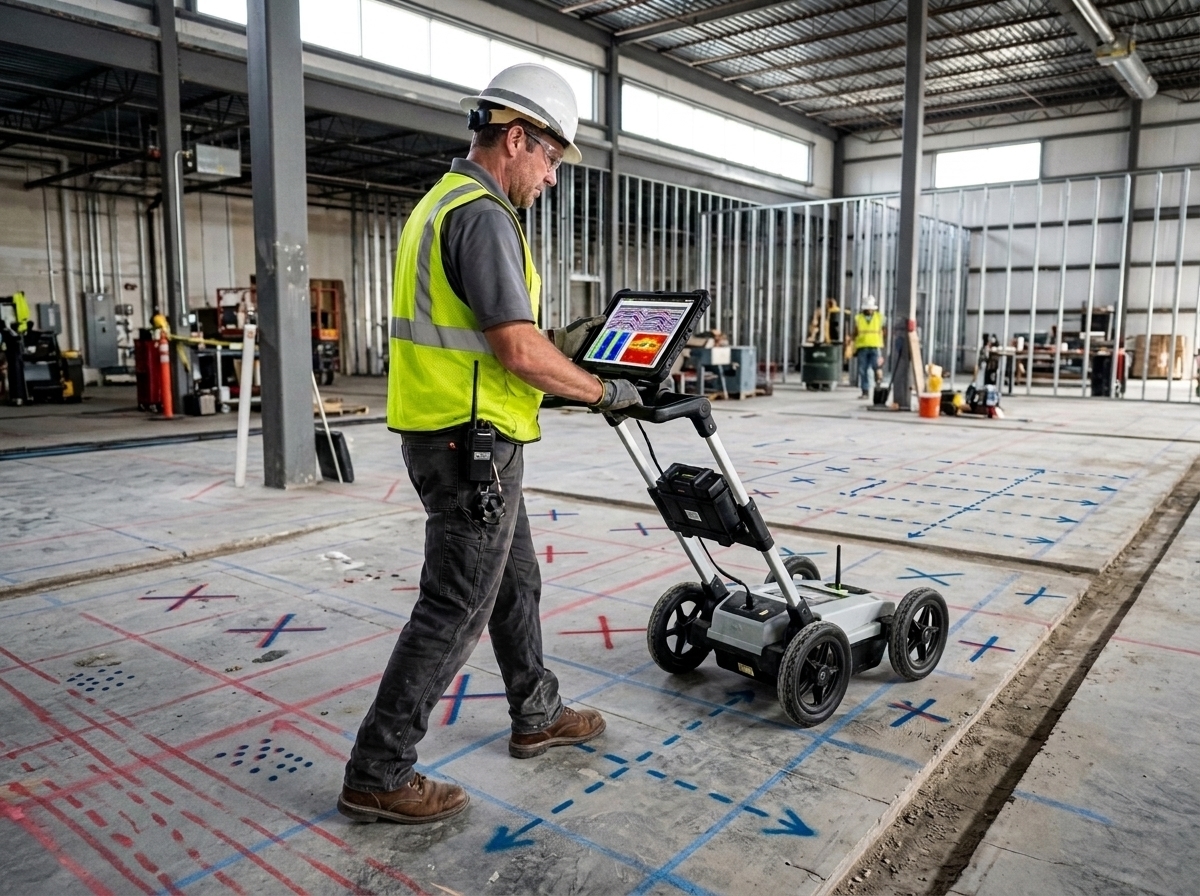
Ground penetrating radar sends radio waves into concrete and records reflections from rebar, conduit, tendons, voids and other embedded items. The operator interprets the results and marks them on the surface. In Salt Lake City, GPR is typically used before wall sawing, slab sawing and coring in existing buildings.
Concrete Cutting Scopes We Handle in Salt Lake City
Illustrative renderings of the scope types, not photographs of completed projects.
Industrial Corridors We Serve
Questions we hear most from owners and GCs.
Salt Lake City Concrete Cutting FAQ
Do I need a permit to cut an opening in a concrete wall in Salt Lake City?
If the wall is load-bearing or part of a shear or fire-rated assembly, you will typically need a commercial building permit with engineered drawings through Salt Lake City Building Services. Non-structural partitions and some small penetrations may be treated differently. Because requirements depend on the wall and the building, confirm with Building Services before cutting, and have your structural engineer define the opening and any reinforcement or shoring.
How do you avoid hitting rebar and post-tension cables?
We scan with ground penetrating radar before wall, slab or core work, mark rebar, conduit and tendons on the surface, and adjust cut locations accordingly. GPR is not perfect in every condition, so we use it alongside the drawings and the engineer's input. If tendons are present, the structural engineer decides how they may be handled. Never cut a post-tensioned slab without scanning and an engineer's direction.
How does the Wasatch Fault affect concrete cutting work?
The Salt Lake City segment of the Wasatch Fault is the main reason seismic retrofit openings, new shear walls and anchor coring are common in the valley. Retrofit designs often require precise pockets, dowel holes and slab openings tied into existing concrete. The cuts must match the engineer's drawings exactly, which makes scanning, layout and clean edges important.
Is blue stakes locating required before coring or trenching?
Utah generally requires notification to Blue Stakes of Utah at 811 before excavation, commonly with at least two business days of lead time, so confirm current rules. Blue Stakes covers public underground utilities, not private conduit inside a slab. For interior cutting, GPR scanning identifies what is in the concrete, and building drawings help locate private utilities below.
What silica rules apply to concrete sawing and coring?
OSHA 29 CFR 1926.1153 applies to respirable crystalline silica in construction. Table 1 lists the controls for common tasks such as handheld sawing and core drilling, which typically include water delivery to the cutting point and, in some cases, respiratory protection. Contractors need a written exposure control plan and a competent person. Owners should confirm the contractor addresses silica in the scope.
What happens to the slurry from wet cutting?
Slurry from wet cutting is alkaline and contains fine concrete particles, so it should be captured with a vacuum or containment, not rinsed into a storm drain. Disposal depends on the volume and the site: it is commonly allowed to settle or solidify, and the solids go to an approved disposal route. Confirm local stormwater and disposal expectations with the city and state.
Can cutting be done in an occupied building?
Yes, and much downtown and Research Park work is done that way. Plans typically include after-hours or weekend shifts, dust and slurry containment, quiet-hours coordination with tenants and freight elevator reservations. Low-vibration methods such as wire sawing and wall sawing can reduce disturbance compared with breakers. Lab and healthcare tenants may need additional coordination around sensitive equipment.
How long does a typical cutting project take in Salt Lake City?
The cutting itself can take days for a few openings or several weeks for large retrofit scopes. Most of the calendar time comes before the saw starts: scanning, engineering and permit review for structural openings often add a few weeks. Confirm current review times with Salt Lake City Building Services and plan float for inspections and rework.
The path from bid to cleanup
Concrete Cutting Project Timeline in Salt Lake City
- 1
Scope, drawings and GPR scanning
Roughly 1-2 weeks
Review the structural drawings, walk the site, scan the cut areas with GPR and mark rebar, conduit and tendons. Issues found here can change the layout before any permit is filed.
- 2
Engineering and permit review
Often 2-6 weeks for structural scopes
Structural openings need an engineer of record and permit review through the city. Minor scopes may move faster, and larger scopes may need additional rounds. Confirm current review times with Building Services.
- 3
Utility locate and mobilization
Typically a few days
Submit the Blue Stakes request where excavation is involved, coordinate elevators and quiet hours, set up dust and slurry controls, and confirm shoring or protection required by the engineer.
- 4
Cutting and coring
Days to several weeks depending on volume
Wall sawing, slab sawing, wire sawing and coring proceed in the sequence the engineer approves. Dense reinforcement and thick walls extend the duration.
- 5
Slurry handling and removal
Concurrent with cutting
Slurry is vacuumed and contained, cut sections are rigged out, and debris is hauled off. Work areas are cleaned between shifts in occupied buildings.
- 6
Inspection, finishing and closeout
Roughly 1-2 weeks
Required inspections, edge finishing, firestopping or sleeve sealing, and cleanup. Dowels, framing or infill by other trades typically follow.
Why owners and GCs call us
Lake Bonneville soils, shallow groundwater and the Wasatch Fault
Most of the Salt Lake Valley floor is a deep basin of unconsolidated sand, silt and clay deposited by Lake Bonneville and by streams draining the Wasatch Range. Depth to groundwater varies a great deal. Closer to the foothills it is often deep, while west of I-15 toward the Jordan River and the Great Salt Lake the water table is commonly shallow. The Utah Geological Survey maps liquefaction susceptibility for the valley because loose, saturated sandy soils combined with strong shaking can lose strength. For a cutting contractor this matters less for the cut itself than for what surrounds it: shallow groundwater means below-grade slabs and basement walls can weep when cored, so planning for water control, sleeves and sealants belongs in the scope.
Seismic exposure drives much of the demand. The Wasatch Fault is a long normal fault, and the Salt Lake City segment is considered capable of a large earthquake. Older non-ductile concrete frames, tilt-up buildings and masonry-infilled structures are the buildings engineers most often flag. Retrofit schemes frequently add new concrete shear walls, collectors and drag struts, which means cutting pockets, coring for dowels and anchors, and sawing slab openings to tie the new elements into the existing frame. These are precise cuts: the engineer specifies location, spacing and rebar clearance, and an overcut at a corner can be a structural problem rather than a cosmetic one.
Frost and climate shape exterior work. Frost depth in the Salt Lake area is often cited at roughly thirty inches, but confirm the design value used on a given project. Exterior slab sawing for control joints, utility trenches and apron repairs needs to consider frozen subgrade and cold water supply in winter. Reinforcement in Salt Lake commercial concrete is commonly dense at columns, beams and shear walls, so scanning with GPR before every wall and slab cut is a practical requirement, not an upgrade. Where the structural engineer permits it, cutting between rebar can reduce the need to sever bars; where bars must be cut, the engineer typically specifies the allowed locations. Slurry from wet cutting has to be captured, because it is alkaline and should not go to a storm drain, and the volume increases when walls are thick.
Salt Lake City Concrete Cutting Capabilities at a Glance
Reference capabilities for Salt Lake City commercial work. Final cut locations, sizes and any structural limits are set by the project engineer and specifications.
- Typical equipment
- Hydraulic wall saws, track-mounted flat saws, wet core rigs and wire saws sized to the member being cut
- Cut accuracy
- Dead-straight overcut-free openings and cores sized to the sleeve, duct or door frame being installed
- Pre-cut scanning
- GPR and rebar scanning before every wall, slab or core penetration; results marked on the slab
- Ground and structure conditions we plan around
- Lake Bonneville sediments, a high water table west of I-15, and Wasatch Fault seismic reinforcement
Permits, utility locates and silica rules in Salt Lake City
Permitting authority: Salt Lake City Corporation Building Services
Salt Lake City Building Services handles building permits and plan review for work inside the city limits, and applications are typically submitted online through its Accela-based Citizen Access portal, with electronic plan review in ProjectDox. Cutting that alters structure, such as adding, removing or enlarging openings in load-bearing walls, shear walls, floors or roofs, generally falls under a commercial building permit with engineered drawings. Purely cosmetic work usually does not. Small cores and non-structural trenching may be handled differently depending on scope, so confirm what your project requires with Building Services before mobilizing. Locations outside the city, such as South Salt Lake, have their own building departments, so confirm the authority for each address.
Utah adopts model codes at the state level and the city enforces them, including seismic provisions in the International Building Code and existing-building rules in the International Existing Building Code. Seismic retrofit work commonly involves a structural engineer of record, and larger projects often carry special inspections for items such as post-installed anchors, epoxy dowels and structural concrete placement. Fire-rated assemblies need to be maintained or restored after penetrations, so core drilling through rated slabs or walls usually calls for approved sleeves and firestopping. Contractor licensing in Utah is administered through the Division of Occupational and Professional Licensing. Which classification applies to cutting scopes depends on how the work is contracted, so owners should ask their GC or the contractor directly instead of assuming.
Before any coring or trenching reaches soil or buried utilities, call Blue Stakes of Utah at 811. Utah generally requires notice to Blue Stakes ahead of excavation, commonly at least two business days, but check current rules. Indoors, a Blue Stakes ticket does not replace GPR, because it does not show private conduit in the slab. On silica, OSHA 29 CFR 1926.1153 governs respirable crystalline silica on construction sites. For wet sawing and coring, the rule's Table 1 pairs tools with water delivery and, in many cases, respirator requirements. Slurry and rinse water should be contained and disposed of properly, and sites that disturb soil may fall under Utah's stormwater permitting overseen by the Utah Department of Environmental Quality. Confirm requirements with Salt Lake City Public Utilities and the state.
Tell Us About Your Project
A few details are enough to start the conversation.
Sources & Further Reading
Local requirements change. Always confirm current rules with the permitting agency before starting work.
- Salt Lake City Building Services
- Salt Lake City Corporation
- Utah Geological Survey
- Wasatch Fault (Wikipedia)
- Lake Bonneville (Wikipedia)
- OSHA Respirable Crystalline Silica
- 29 CFR 1926.1153 Respirable crystalline silica (eCFR)
- Blue Stakes of Utah
- Utah Division of Occupational and Professional Licensing
- Utah Inland Port Authority (Wikipedia)
- The Gateway, Salt Lake City (Wikipedia)
- S Line, Utah Transit Authority (Wikipedia)
- University of Utah Research Park (Wikipedia)
- Salt Lake City International Airport (Wikipedia)
- NWS Salt Lake City climate and forecasts
- EPA Stormwater Discharges from Construction Activities